PeterRS
Members
-
Joined
-
Last visited
Everything posted by PeterRS
-
There are probably gangs in most major cities. Many are violent. It may come as a surprise that there are deadly rivalries between student gangs in Bangkok - notably Technical Colleges. When I say "deadly", that is precisely what I mean. Few if any tourists and residents will be aware of them but they are to be found near at least one major shopping mall – MBK. This report from Channel News Asia formed the basis of a TV documentary shown some months ago. It is almost frightening. BANGKOK: Vocational student Kamonwich Suwanthat was interning at a multinational logistics company and was a few months away from graduation. His parents were certain his education would change the family’s fortunes. Until then, the 24-year-old was also helping his mother to make ends meet by selling noodles at her roadside market stall on most nights. That was where, on Oct 12, a stranger shot him four times, point-blank, and fled. The fourth-year student bled to death in front of a crowd and his mother. She did not realise it then, but his place of study was the reason he was targeted — by a school gang. The three students arrested a month later told the police they had no personal dispute with him, and gave this statement: “He was chosen simply because he can be killed in the same way his schoolmates killed our senior.” They were from the Pathumwan Institute of Technology located just one kilometre from the victim’s school, the Rajamangala University of Technology Tawan-ok, Uthenthawai Campus. Deadly violence between vocational students with a potentially bright future is common in Thailand. In Bangkok alone, there are years when more than 1,000 cases of brawls have been reported by mid-year. And the rivalry that cost Kamonwich his life is a seven-decade, tit-for-tat grudge between two schools in the same neighbourhood as the MBK Centre, the giant shopping complex popular with tourists. “Once I knew it was a school rivalry, I knew the (shooter) couldn’t be anyone else but a student from the institute nearby,” said Thai Rath TV crime journalist Nattapong Riabsantia . . . When Thai youths leave high school, they are separated into general or vocational education tracks. Those who pick the latter enrol at one of Thailand’s 416 vocational institutes to learn trade-specific skills. Pathumwan Institute of Technology is one of them. The 87-year-old school trains future mechanics, technicians and electricians, among other trades. Despite its notoriety, this is where 19-year-old Nim chose to study electrical engineering “because what I learn will allow me to find work back in my hometown”. Her first semester, however, shows how the troublemaking can start. She signed up for a welcome camp that turned out to be a hazing experience — a rite of passage centred on loyalty to the school that brought the students together. These camps, organised by the seniors without official sanction, are common in many Thai colleges and last mostly a week to a month. But at Pathumwan Institute, there can be such activities for the whole semester. Nim (her nickname) gave up after two weeks. But those who endure get a “special’ T-shirt with the school crest, which they wear like a badge of honour. And that invites danger. Benz, a fourth-year senior, said: “When we wear a school shirt with a logo, it’s very easy for us to spot who wants to fight or who wants to have power over us.” To students like him, however, the school crest is a way to gain respect. Fees for vocational colleges are heavily subsidised, so they attract students from poorer areas that rely on agriculture. They often must leave their families living outside the city but get a chance to be initiated into a tight-knit fraternity. “Being part of this helps me to overcome an inferiority complex,” admitted Benz. Third-year student Pae added: “We’re like family. The minute I step in, someone will greet (me) and ask if I’ve eaten … ‘Do you have money for food? I’ll give you money.’” As new members learn to beware of students from a long-standing rival school, it is often their sense of loyalty and belonging that drives them to acts of violence. Pathumwan old boy and former army soldier Sompode Subpradit would know. He was expelled from the school 50 years ago for taking part in violent brawls. Now that he is retired, he “always” visits the school, and the students see him as an elder brother. Having listened to them, he said: “Sometimes the love and bond between friends and juniors is the reason for the violence. “If a junior student is attacked by a student from the rival school, the seniors would be sad and would take revenge to protect the school’s pride.” Over the years, the authorities have tried all kinds of measures to stop school gangs, from sending offenders to army boot camps to discipline them, to holding outreach programmes. Even a nationwide oath of peace, taken by almost a million vocational students in honour of King Bhumibol Adulyadej when he died in 2016, has not ended the inter-school violence. At Pathumwan Institute, students have worn a standard vocational college uniform since 1975, which many other colleges have also adopted. This uniform does not have the school logo, making its students indistinguishable from others. They are also told to be cautious, and the rules do include not allowing them to wear the school’s logo or colours outside the school grounds, in a bid to prevent rival students from identifying them. But it is clear that there are renegades flaunting their school crest. And the Thai police continue to enter the fray to stop the bloodshed. “Typically (from past cases), students use knives to stab each other. They’d grab the rival’s neck and stab him,” said Suppression Squad Leader Sarun Ausub from the Pathumwan District Police Station. “If we (the police) aren’t there to check on them, they may stab each other to death. That’s happened before.” A clash in August 2017, for example, which happened outside the MBK Centre, left one student dead after he was stabbed. Since then, the police and both schools have come together with a plan to stop these brawls . . . The Kingdom faces a shortage of technical and vocational workers. And violence among schools only pushes parents to steer clear of vocational education for their children, even though for some, their livelihood from farming now brings dismal returns. Pae is one of those from a rural area. He has been suspended for one and a half years for staring rival students down. But he has not given up on studying, “no matter how rebellious” he is. “It’s my dream to study here,” he said. “I’m poor. My mother is poor. If I don’t try, I won’t be able to survive.” Kamonwich, on the other hand, lost that chance simply because his profile — most likely picked out via social media — was similar to a Pathumwan old boy who was killed while selling food with his aunt. Mr Nattapong, who interviewed Kamonwich’s parents, said: “I could tell they were so sad from their eyes, because they’d just lost the son who’d have one day been a tower of strength for the family. “I’ll never understand (why vocational students fight). I can’t believe they kill each other because of reasons that are nonsense. The students shouldn’t die like this, because some of them really want to study peacefully." https://www.channelnewsasia.com/news/cnainsider/shopping-haven-mbk-bangkok-thailand-deadliest-school-rivalries-11547204
-
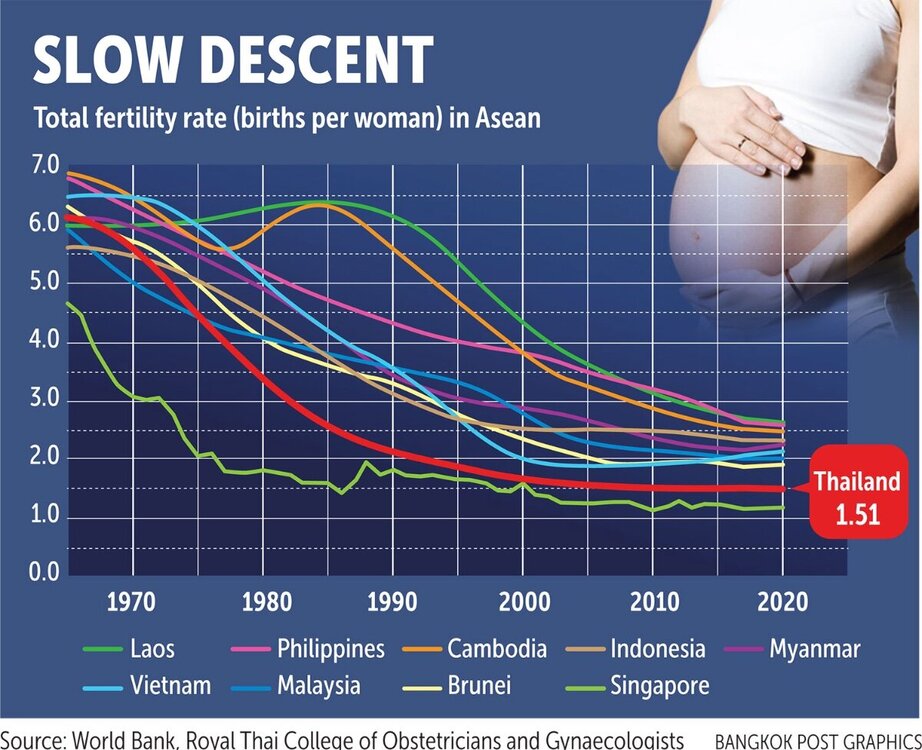
I'm not wholly convinced that the falling birth date can be considered a reason for a reduction in the number of Thai gay boys and those working in the bars. As this chart shows, the Thai birth rate has been relatively constant over the last 20 years. I reckon most boys in the bars would traditionally have been in the 18 - 25 range. So today that would mean boys born between around 1996 and 2003. There was certainly a largish dip between about 1996 and 2001 but not markedly so since then. What the chart might reveal is the reason for so many Thai boys working in the bar scene in the 1980s and early 1990s. An even more obvious reason IMHO would surely be the campaigns run by the government in the 1970s and 1980s to discourage parents from having too many children. The birthrate in 1970 was totally unsustainable and had to be brought down. Mechai Viravaidya took it on himself to devise ways to make birth control acceptable throughout the country. He popularised the use of condoms with events like condom blowing contests to the extent that they became known as "mechais", and made oral contraceptives available without a physician being involved in the transaction. I am sure many readers have been to his restaurant Cabbages and Condoms in Sukhumvit Soi 12. Perhaps Mechai was too successful. But as the chart shows, birthrates have fallen dramatically over the entire region, although it is true that they have not fallen as much in neighbouring countries, even rising in Vietnam.
-
I agree with almost all the comments of both @reader and @z909 in their recent posts. I have just two points. 1. We all know only too well that millions of votes in Thailand are bought. Thaksin won 20 years ago because he dispensed vast sums to village leaders who then told their communities how to vote. He then used the powers of the state to hide this corruption and the fact that he should never have been elected in the first place since he had hidden vast amounts of his assets and not declared them as mandated by law. Did anyone seriously believe that his housekeeper and gardener each owned many millions of shares in his company? Of course not. But then he bribed the Constitutional Court to look the other way and it ruled 4 to 3 that it was a genuine oversight! Please do not mistake me. Thaksin did a lot of good for the country. He also did quite a lot of bad and he again used the levers of power to ensure he personally did not need to pay nearly 2 billion baht in tax on a share sale. By controlling the media and having some journalists and editors fired, he ensured much of his dirty deeds were given little coverage. His extra judicial killings of almost 2,500 people, he alleged before a crowd, had rid Thailand of drugs. As if that lie justified those deaths! Then take his sister whose strings were pulled by her brother exiled in Dubai. The rice pledging scheme was known to be a massive economic disaster before it was even implemented - every rice expert in the world said so - but it was popular in the countryside. How many billions did it lose? Around 600 billion baht and it is estimated it will take the government - i.e. the people - another 8 years before that debt is finally paid off. The implementation of the one tablet per child was another popular vote catcher but a disaster in its implementation. After the debacle of the Chinese firm awarded the contract to supply them being unable to fulfil it, all the kids who finally received tablets wanted to do was play games on them! I won't go on. I suppose my point really is: did those in the countryside - the majority of the population - really know what they were voting for? Did they know the effects this would have on their villages, towns and the country as a whole? I doubt it. There are few democratic institutions in Thailand, few checks and balances, and those that exist can be bought by those in power. Just providing one man with one vote does not democracy make! Until Thailand's education system teaches all kids about democracy and how it should function - almost the same as Taiwanese kids being taught Confucius' values as part of their curriculum - and until real checks and balances are put in place, Thailand is never going to have anything more than a sham democracy. 2. The thread is about Gay Pride and who leads the way to Equality. I have made my points about Pride marches being taken over by those with a separate agenda. My own view is that a Pride march here should have just three goals other than showing the government and the public that there is a strong gay community out there - understanding, acceptance and equality. The organisers have to ensure that March participants agree to this and to have Parade marshalls along the way to ensure that the March takes place smoothly. Diluting the message with political and other objectives ruins it.
-
I believe that would be Australia but I do not know if there are specific requirements of non-citizens. Other readers might know if the couple have to spend any period of time in the country between registration and the actual marriage, for example. That might make it quite a costly venture for two people.
-
I will be really interested to find out how many couples will be affected by this Court ruling. After all, it depends on the couple being legally married, something that is not possible in Hong Kong and I suspect there are very few. Flying over to get married in Taiwan is not going to help because Taiwan's gay marriage law requires one partner to be Taiwanese.
-
Taiwan is of course different. But, with respect, I think you forget that Taiwan was a very poor island under a repressive authoritarian military dictatorship for 40 years until 1987. During this period and for 15 years beforehand Thailand was supposed to be a representative democracy. Chiang Kai-shek did not believe in elections. He believed firmly in Confucianism and rule from the top. Politics was a matter for the elite, not the average citizen. Only three parties were permitted in elections - his own island-wide Kuomintang and two far smaller ones. Although Chiang's son introduced democracy. Chiang Ching-kuo was of almost the same mind as his father. The difference was that he understood the shifting international ground re Taiwan's position in the world. Even after introducing democracy, he all but ensured that Chiang Kai-shek's Kuomintang Party won elections and kept winning them. His major contribution was ensuring a greater social and economic freedom which the Taiwanese grabbed with all hands. The KMT finally lost power in the 2000 elections but regained it in 2008 after major corruption scandals rocked the Democratic Party. It was Sun Yet-sen who tried to introduce democracy in China following the overthrow of the Imperial system. That failed, but his teachings found their way to post War Taiwan and all children are taught them in school. But it seems unlikely these would have had much effect without the massive economic advances made after the elder Chiang's death. Taiwan's economic growth was nothing short of spectacular. As @reader points out, the distribution of wealth was spread wide thereby generating a national cohesiveness which enabled democratic institutions to be established and reinforced. Taiwan's population gave the government, even though it was the KMT, credit for making the economic miracle happen. Taiwan's GDP in 1952 was $1.33 billion. By the year 2000 it had risen to $330 billion! By then, though, cohesiveness was not a result of issues with mainland China, for Taiwan companies had been increasingly investing in China where it employed huge numbers of Chinese citizens. China was far too busy with building its own economy. It is only very recently that the Taiwan issue has once again come to the forefront. If there is a lesson from Taiwan, it is surely that Asian countries need to develop economic growth and ensure this trickles down throughout the population before spending time on developing democratic institutions - especially in a country like Thailand where extensive corruption is endemic throughout the country. Thailand has had in effect only one decade of major economic growth - from 1986 to 1996 when annual GDP increases averaged 9%. Thereafter corny capitalism and corruption resulted in the Asian Economic Crisis starting in Thailand and putting the entire country back well over a decade. And then came the 2008 finical meltdown affecting most of the world. The dilemma for Thailand is therefore: how to get rid of corruption and ensure not just clean government but one that has the interests of the entire nation at its core. That will in itself bring greater equality. But how you achieve that, given the country's history, I have not the faintest idea. I believe it only has a chance when the country develops leaders who themselves are neither kleptomaniacs nor crony capitalists like almost all who have risen to the top of the tree in recent decades.
-
I am sorry I cannot answer your question. I can only assume though there has to be quite a lot of gay sex around all the towns and villages. Several organisations sprang up in the late 1980s and 1990s to take the message about HIV prevention and condom use around the country. Before I was partnered six years ago I travelled quite a bit around the country and had no difficulty finding attractive guys in places like Udon Thani, Ubon Ratchathani, Maha Sarakham, Korat, Khon Kaen etc. Also, surely if he is looking at sites like Hornet and Romeo he is going to see mostly farang? I understand there are several Thai only sites in Thai and these must be pretty active. But another issue that has to be considered, sadly, is familial incest. I have a friend from Chiang Rai who was molested quite a few times by his uncle when he was 14 and 15. He only found out when he came to Bangkok to study at the flight academy. He passed all his exams with 'flying' (sorry) colours and spent secondments with two airlines at BKK working in passenger services. His dream was always to work with an airline. But he then discovered the qualifications for every airline said "HIV neg essential". Odd that this was not a problem during his training. He ended up working on the front desk of a major hotel. He is paid well but his heart is not in it. He still has hopes that he will be able to work with an airline eventually.
-
From what I have read, Bangkok's Pride Parade which had taken place for several years died in 2006 largely because of disagreements between the organisers and arguments amongst the mostly farang-owned gay businesses which had traditionally provided its financing. That year it attracted quite a large crowd of onlookers but I suspect this was partly due to the fact that it was held on the same day as the annual Loy Krathong Festival, one of Thailand's most loved events which attracts a lot of tourists. A very small Parade was held last year but the route was only between Sam Yan and Silom. That is an extremely short distance which you can walk slowly in not much more than 20 minutes. In Taipei the March lasts around 3 hours. By the time last year's Bangkok March reached Silom, numbers had reached between 1,000 and 2,000 depending on which news media you read (Reuters quotes the smaller number). However, let's be very frank. That was not a Gay Pride March celebrating gayness. Although it started out with some political objectives by calling for greater democracy and equal rights, it was infiltrated by others demanding the resignation of the Prime Minister and a reform of the monarchy. Any group of people with some calling for the latter two objectives was in my view ultra stupid. For what should have been a celebration of being gay, that other group used gayness for non-gay political purposes and therefore seriously diluted the primary message which I suggest should have been equality. If anyone doubts that, guess what the media coverage highlighted? Taipei's annual March has always has a simple social message - but just one message that all in society can relate to. Occasionally it has incorporated a simple political message but it has never aimed to divide, only encourage. Also being frank, the enormous success of that March - and later the other Pride marches held in other Taiwan cities - unquestionably played a key part in the result that Taiwan is the only country where gay marriage is now on the statue books. Many in last year's Bangkok marchers wanted political reforms. That should have been a totally separate March in my view.
-
I also voted 'Other'. I would have preferred one selection either being 'Asia' as a whole or adding in 'North Asia'. I live in Thailand and I will be visiting Japan and Taiwan just as soon as it becomes possible. I may also add in South Korea not having been there for about 15 years.
-
I have hardly watched any western gay porn since the days of Johann Paulik and his Bel Ami vdos. So I cannot comment on current standards. On the other hand, I have watched far more Asian porn and seen how some of the producers have developed with product that offer great looking models and considerable creativity. Japan has had its own brand of gay vdos for decades. Some of the boys, especially if you are into twinks or heavy butch types, look amazing. Unfortunately, too many are totally formulaic. See one and you have seen a thousand others, although you will occasionally find a studio that features mcch stronger story lines. Then the curse is that so many are stuck with Japanese law which demands pixelation. Sadly for us today, Japan had no such restrictions in magazines, books and its famous erotic wood carvings until westerners arrived with Commander Perry followed by shiploads of Christian missionaries. Such carvings (shunga) had in fact been banned during the later Shogun era but the ban was never really enforced. Since the end of World War 2 and the American occupation, much more attention has been paid to the Code in Japanese law restricting the distribution of 'indecent' materials. Hence the arrival of pixelation! It all seems so ridiculous given that nudity is not a big thing in Japan. In fact in Japanese hot springs and public bath houses it is totally common. But . . . ! A lot of Korean porn is also pixelated. More is acted out but nothing is really seen apart from tits and ass. Taiwan seems to be turning out much better short videos with great looking models and decent story lines. I have rarely seen movie-length Thailand videos,Most of what is produced seems geared for internet with little creativity - the same shots, same crude story lines but often some great looking models. Am I missing something?
-
Daddy - please, I want more beef!
-
Thanks @spoon. Sorry I was not specific. I was more interested in what i have felt is a gradual return to religious fundamentalism in Malaysia than in attitudes to gay sex. From visiting the country and reading both local and international media, it seems to me that Islam has become more fundamentalist over the last 40 years. Four years ago the United Nations Commission on International Religious Freedom reported that in the Malaysian context "it seems the brand of Islamism in Malaysia is prohibitive and restrictive, bordering on extremism." There also seems to be a growing rift between majority Sunni and the tiny minority of Shi'ite observers. I read that Shi'ism is banned and exists largely as a result of Saudi funding. In recent years the stricter Saudi version of Wahhabism has started to take root. And if Islam has in some areas become more extreme, I assume that bans on homosexual behaviour may also be becoming more enforced. Just thoughts.
-
On this point we agree. I also believe change will happen. History tells us that change is inevitable. The question then is: how long will it take? In the West and the Antipodean countries, it has come with quite remarkable speed when you consider that homophobia was quite aggressively the norm in the 1950s and even 1960s. But we cannot take those territories as an example of what will happen in Thailand and indeed much of the rest of the world. I believe it will take several generations - perhaps even a century - for deep-rooted beliefs to change. There is a reason why homophobia and anti-gay rhetoric rules in Islamic societies - it is ingrained in beliefs that are around 1,500 years old. Forget that Islam has had its own homosexual culture at times. These were surely more an aberration than any form of change. Even today in what we would probably call first world Islamic countries, homosexuality is still a major crime. When I spent three days in Doha a few years ago, there were two absolute no-nos - booze (apart thankfully from in my hotel's bars and lounges) and men having sex with men. Nothing in the last 60 years has changed that. If anything, I suspect the rise of militant Islam has resulted in a deepening of traditional beliefs. I would like to hear @spoon's view in terms of Malaysia. I first visited for a week's vacation about 40 years ago. At that time and for quite a few years thereafter, I noticed no hardening of Islamic views. The gay bar Blue Boy was packed virtually every night (great memories!!), there were several cruising areas including a very active large dark open-air car park in the evening and gay saunas were opening. More recently I have seen hard liners in parts of the country and in the media asserting themselves and their more hard line views. Are the youth of the country willing and able to change that? Let's also remember that hardening of positions re sexual matters is not limited to Islamic countries. Ultra-right wing governments are pushing back previously more relaxed boundaries. Look at Russia. Look at the Hungary's new bill passed last week. They are moving back in time. I also believe it is wrong to link an easing of sexual views and restrictions with political reform. With the greatest respect, I feel this is more of a western concept than an Asian one. Thailand's political model introducing a degree of democracy is less than 90 years old. It was forced upon the country by a small group of the military allied to an equally small number of civil servants and the intelligentsia. It had absolutely nothing to do with any political movement that had germinated and developed in the countryside. Yet many, especially amongst the existing elite and the power brokers, still hanker after the old model. Why is it that since then Thailand has had more military coups than any other country on the planet - 13 successful ones and 9 unsuccessful ones? A "coup culture" is becoming almost as ingrained as homophobia! Can students overturn this? Is there a general view amongst the country's students that change must come? Will students, like their counterparts in France in 1968, lead a general movement that includes strikes, occupations of factories and government offices in order to achieve change in Thailand? I fear not.
-
In this and another thread I have ben promoting a sometimes unpopular view about Thai society and its views on gays in particular. I think Khun Sirisakposh makes an important point when he says - "Gender discrimination is deeply entrenched in Thai society, and it’s so subtle that people don’t usually see it."
-
I think it is great that as many as possible contribute. I certainly don't see any contribution as highjacking. Let's have more. But I just feel - and it's a personal view - that looking at the situation of being gay in Thailand from a western perspective inevitably leads to quite a few inaccurate conclusions. I have seen the decorations at Sam Yan and am delighted they are there. Yes, it is close to two Universities. But I have to add that there are more than 50 Universities in Bangkok! What have they been doing to celebrate Pride month I wonder? Merely a question because I just do not know. Also, let's be frank. Sam Yan really is not a major hub in Bangkok. My guess is that students at Chula University are more likely to alight at Siam. Now if that display had been in the Siam/Paragon area, I believe it would have had a far greater effect. Still it is a start. I am certain that many students in other cities throughout the Kingdom are much more pro-LGBT than their elders. Students are often at the forefront of social change everywhere. Hopefully this might be true also in Thailand. But I believe it is vitally important to remember that students graduate and many move into the professions. And it is in those very professions where there is entrenched homophobia in this country. Will most of them be so keen to be known as gay when promotions, salary increases etc. are dependent on being seen to fit in to accepted norms promoted by the older generations? Will they march if there is a Pride Parade in, say, 5 years time? The graduate generation before them have not and probably will not, alas. Will major Thai corporations like TRUE or AIS contribute with cash and banners, as is the case with locally based companies at Singapore's Pink Dot after the government banned the many international companies from becoming involved? I am less convinced by those commenting in the media. Yes, there have been articles going back at least to the early 1990s. I have already mentioned Khun Natee who deserves far more credit than I believe he is given for really starting a nascent gay rights movement. Yet his base is in Chiang Mai and it was in Chiang Mai in 2009 that its second Pride Parade was shouted down by local inhabitants and had to be abandoned. It took 10 years before another could be considered. When was Phuket's Pride parade cancelled - three or four years ago? An article in Coconuts (below) states that the number of taking in the 2016 March along the Patong beachfront was 100. Just 100! It adds that, as in Bangkok years earlier, farang were involved in the organisation. I cannot stress enough my view that having farang in any key positions in the organisation of a Parade/Pink Dot or other celebration here in Bangkok is a recipe for a non-event (and I know some farang will scream at this!) I also think if the Parade is anywhere close to the gay areas in Silom/Suriwong, it will fail. As I have again stated, Taipei's Pride Parade works amazingly primarily because it has always been organised by a group of locals and, as far as I am aware, steers clear of the only major gay locale - the Red House. Returning to the subject of those being open about being gay in the media, as I stressed earlier if you take away the hospitality, arts, entertainment and fashion industries which traditionally have a large number of gay employees in most countries, I have seen very few Thai individuals commenting about being gay. Even in that group of four industries I listed, there are also huge numbers who are gay, who are known by their colleagues to be gay and who are written about as though suspected of being gay by the entertainment media - but they will still not consider coming out as gay. https://coconuts.co/bangkok/features/thailands-only-pride-parade-marched-phuket-photo-essay-0/ As for local views in the countryside, there was an interesting article in the Bangkok Post five years ago at the time of the Gay nightclub shooting in Florida. Perhaps this puts homophobia in Thailand into a better perspective. . . . truth be told, homophobia isn't the exclusive terrain of any particular religion or country. Those who think that Thailand is immune to such homophobia and violence against lesbians, gays, bisexuals and transgenders (LGBT) have been fooled by the myth of "acceptance". In fact, local media has reported cases of violence against this group. A few years ago, a woman admitted to having her daughter's lesbian lover killed in Trat because she wanted her child to date a man. The victim clearly was murdered because of her sexual orientation and gender identity -- she was a tom, the Thai term for a self-styled masculine lesbian. In another case, two 17-year-old students in a lesbian relationship were found dead in Nong Khai with more than 60 stab wounds between them. Police suspected they were killed out of jealousy over their relationship. Moreover, many lesbians are subjected to rape in order to "cure" their sexual orientation, often by their own family members -- a subject rarely discussed due to the stigma around rape and lesbianism. A father in Loei confessed to having raped his 14-year-old daughter for four years in order to stop her from socialising with tom. Worse, there is a worrying trend that this so-called corrective rape is being normalised in Thai society through the expression Kae Tom Som Dee or "fixing tom and dee" – dee are the feminine counterpart to tom . . . Therefore, if we are shocked by this senseless loss of lives in Florida, the first thing we should do is to fight the root causes of homophobia in our own backyard, where much of the medical profession still considers transgenderism as a form of mental disorder; where the predominantly "Buddhist" population believes that LGBTs are sinful for past-life adultery and therefore deserve lower status; where all junior high-school students are taught by government-approved curriculum that homosexuality constitutes sexual deviancy; and where popular TV programmes regularly caricature LGBTs as promiscuous and spreaders of HIV/Aids. https://www.bangkokpost.com/opinion/opinion/1009557/we-need-to-fight-homophobia-at-home
-
A very good point which Prof. Jackson makes quite clearly. My assumption should therefore be wrong. On the other hand, I do not know how else to interpret this part of Prof. Jackson's introduction. He states the following: "In this study I draw upon Butler's Foucault-influenced account of the perfomativity of gender and sex to trace the ways that shifts in the forms of bio-power over gender in Thailand not only altered norms of masculinity and femininity but also radically changed patterns of desire and identity. I account for the emergence of the new Thai identities and gender/sexual cultures by mapping out a precise character of changes in the forms of power that the Thai state deployed in its efforts to 'civilise' the public gendering of the populace - a project of power incited into being as a response to the combined challenges of English, French, Japanese and American imperialisms in Southeast Asia in the nineteenth and twentieth centuries. This study reveals that even in the absence of Western-Style interventions in sexuality, the disruptions of traditional Siamese culture caused by the state's response to the West radically altered the performative norms of masculinity and femininity, which in turn contributed to the proliferation of new forms of transgender and same-sex identity. This Thai case study provides a counter-example to the presumption that modernity and globalisation necessarily lead to an international homogenisation of sexual cultures." Norms of masculinity and femininity - patterns of desire and identity - new Thai identities and gender/sexual cultures - disruptions of traditional Siamese culture caused by the state's response . . . radically altered the performative norms of masculinity and femininity . . . etc. All this seems to me to indicate that nothing the state did altered what had been accepted in Thai culture for a very long time, including male to male sexual relations. Prof. Jackson adds in his Para 5. "Unlike the situation in the West, where both homosexuality and cross-dressing had long been explicitly prohibited, until the later decades of the twentieth century same-sex and transgender behaviours almost completely escaped the attention of the Thai authorities." I take Prof. Jackson's study as a whole to indicate that homosexuality as we know it did exist in Thailand and that it was in no way frowned upon by the state or indeed the public as a whole. But as I have written, it is a very long Paper and I certainly have not taken it all in. I am perfectly happy for others to contradict assumptions I have made based on the texts of the two articles from which I have quoted part. The important issue for me was to air the subject, for it has long seemed that some/many hold views about being gay in Thailand that are based much more on what is happening in the west rather than on the reality of the situation as it has developed over centuries in Thailand.
-
HOLE! Another culinary analogy. Toad in the Hole is a traditional English dish consisting of sausages in Yorkshire pudding batter, usually served with onion gravy and vegetables
-
Yes, eunochs were castrated. In Beijing, they were the only men permitted to reside in the Forbidden City other than the Emperor's family and members of the Court. Castration was to ensure they did not sleep with any of the ladies in the Emperors harem! But in line with Chinese beliefs, their excised parts were kept in jars so that their bodies could be buried whole. In some countries only the testicals would be removed. In China, Korea, Vietnam and other parts of Asia I believe the penis was also removed. I read that the Third Emperor of the Ming Dynasty, Zhu Di, took a fancy to Vietnamese boys during the occupation of Vietnam by the Chinese. Many were castrated and brought to Court in Beijing presumably for his enjoyment. Generally, though, castration was not for sexual reasons. Starting early in the Ming Dynasty eunochs were permitted to marry and so appear 'normal'. But the ceremonies were usually secret. Eunochs were not confined to Asia, especially in ancient times. Even in the 17th and 18th centuries, boys were castrated in Europe in an attempt to save the purity of their pre-pubescent voices. Many died during the crude operation and most of the others lived very lonely poor lives. Those that made it became quite literally superstars. One, Farinelli, about whom a movie was made in the 1990s, was the pop star of his age and made a fortune. For whatever reason, women adored him!
-
I like him. He'd probably be on my list, but not at the top. I had also not heard of him before the Asia 's Got Talent series. If you start watching Korean, Chinese, Taiwanese and Hong Kong movies there is a whole panoply of beautiful young guys, some more talented than others. Two I like are both actors. Deng Lun is Chinese and has recently become very popular with his boy next door look. The Taiwanese actor Luo Yun-xi looks more of a bad-boy type. He started training as a ballet dancer around age 5 and continued ballet till he was in his early teens. Since then he has become a singer and actor. He's better known as Leo Luo. Looks like he could be a lion in bed


-
Looks like Thais will end up with vaccines which are deemed by some as less efficient. There will still be the local AZ vaccine but Australia has just announced it will stop using the vaccine from October. The country claims to have 2 deaths from severe blood clotting following vaccination. More worrying is that the numbers infected in Thailand are not falling while the number of deaths increase - 3,174 and 51 today, the highest daily totals since the pandemic started. Bangkok's state-run hospitals announced they now have only 20 available intensive care beds. https://www.theguardian.com/world/live/2021/jun/23/coronavirus-live-news-thailand-record-daily-deaths-tokyo-olympics-alcohol Take care, guys!
-
Apologies! I moved in a bit East!
-
I believe it is more complicated than that. It's hard to explain succinctly because Professor Jackson's writing is far from simple - at least for me! I certainly I believe Jackson does not mean that kathoey means transgender, merely a man who adopts a more feminine outlook. At one point in the first Paper, he writes about Anna Leonowens' concerns when describing inhabitants of the Royal Palace. (This was the English teacher as later portrayed as 'Anna' in "The King & I" the popular Rodgers and Hammerstein musical.) She served the King for 5 years from 1862. At this time King Mongkut had 39 wives and concubines and 82 children. Anna later wrote, "Here were women disguised as men, and men in the attire of women, hiding vice of every vileness and crime of every enormity - at once the most disgusting, the most appalling, and the most unnatural that the heart of man has conceived." Yet, as Jackson points out, what Ms. Leonowens actually saw were the somewhat Amazonian female guards of the King's harem and actors performing in one of the all-male troupes. As in the time of Shakespeare, men took on the role of women on stage. She had simply failed to note much gender differentiation between men and women. "All Siamese women were perceived as masculine and all Siamese men as feminine," wrote Jackson. Even in the late 1940s, a Study of the Thai village of Bang Chan (now a suburb of Bangkok) noted that "there are very few cultural roles, apart from those associated with religion, which can not be played by either men or women . . . Thai culture in its secular aspects seems to consider all adults as simply human beings together, without major distinction of sex roles; behaviour which is appropriate to one person is equally appropriate to another." In this case, the word "roles" does not refer to a stage play. It merely means in life in general. He then adds from the same Study, "The degree of equality between the sexes which exists in Thailand . . . is a characteristic which strongly distinguishes the norms of Thai society from those of India, China or Japan, or even the Catholic Philippines and Muslim Indonesia. It is a characteristic which predated the influence of Hindu culture and the acceptance of Buddhism with their androcentrism and emphasis on masculine values." Thus the sameness of the sexes in Thailand is millennia old. As seems to be indicated by that Study - equality also refers to sexual relations. But the Westernization of the people by imposing the mandate that women and men dress very differently and specifically had also resulted in changes in attitudes to sex. Last point. There are virtually no references to kathoey until a 1924 newspaper article. It is only after World War II that the term becomes more commonly used. I suspect (and it is nothing more than that) that by enforcing a different dress code for men and women, thereafter it became much more difficult for men to have sex with other men. After all, in the past it would have been difficult for others to tell who were men and who were women! With the completely new dress code, the kathoey looked feminine and so became attractive to men seeking a homosexual tryst. I'm sorry, that is all far from simple! I hope it makes some kind of sense.
-
Just a bit of fun! I saw a programme on TV the other evening titled No Sleep No Fomo. (I still do not know what Fomo stands for!) Each episode is a rather crazy 60 hour romp with a host from Singapore and an Asian pop star who do a series of odd challenges in various parts of Asia. I felt I had seen enough pop stars I'd like to spend time (i.e. a night) with - even if they are not gay and not single - that I could not be bothered with any more. Then of course, someone in a K Pop group or an actor in a movie gets the urges going again. In this episode I saw my latest. Eric Nam is a Korean of American descent. Born in Atlanta, when he was 23 he spent a year studying International Studies and Mandarin in Beijing. Back in New York he worked for Deloitte Consulting before one of his youtube videos went viral. He then moved to South Korea where for 9 years he has become hugely popular as a singer, actor, dancer and promoter of two regular podcasts. These have included interviews with loads of international celebrities including Matt Damon, Robert Downey Jnr., Emma Stone and Jamie Foxx. He was named GQ Korea's Man of the Year in 2016 and was included in Forbes' 30 Under 30 Asia in 2017. Clearly highly intelligent, he is like many pop idols extremely secretive about his private life. He seems not to be married!! But I'll bet there's a lover there somewhere! He's too cute to be single
-
I agree with you, but the point of the thread was to look specifically at Thailand. It's a country where male-male same sex liaisons had been far from uncommon for centuries and were clearly universally tolerated, as long as the participants fitted the man-katheoy model. Also, sex was, as Professor Jackson writes in the OP "something ordinary, a matter of teasing and playful banter such as is apparent in folk songs, artwork, poetry and so on." Today most of the world regards Thailand as one of the most gay tolerant countries in the world. Yet my point was that 'gay' did not enter the vocabulary until around the mid-1960s and that when Thais realised that this meant men acting and dressing as real men having sex with other real men, tolerance of same-sex customs was virtually shattered. It was essentially a new concept. It did not fit the traditional model and it was actively disliked. It altered attitudes to sex. All this will have filtered through to the countryside only around 50 years ago and so will still be a commonly held view today by older generations. Given the importance of the family and village structure (as Londoner points out above), I suspect it is a view that is still being passed down to younger generations and it is one reason why so many Thai gay men remain afraid of the consequences of coming out. This is not at all similar to Western countries where same sex liaisons were frowned on for centuries and even criminalised, but we know they took place. Indeed, they were no doubt a lot more common than is in fact known from those cases like Oscan Wilde's and Alan Turing's which were brought before the Courts.
-
I can assure you it is not just in the villages. Look at almost any major business in the major cities (outside entertainment, the arts and the hospitality industry) and you will find in general the same sort of anti-gay discrimination.